Tuesday, 1 April 2014

Israel Supreme Court decision only symbolic

Aftermath of Operation Cast Lead
This article examines the recent announcement that Israel Supreme Court will hear evidence of war crimes of military operations in Gaza and Lebanon. These attacks killed at least 1,400 Palestinians in Operation Cast Lead over three weeks, only 400 of these killed were proved to be fighters. Despite the injustices, Israel only investigated low- level officials. The longest sentence of 7 months was handed to a soldier who stole a credit card in the operation.
At first I was optimistic to hear Israel was willing to listen to evidence of war crime against some high profiles such as Former Prime Minister Ehud Olmert. However when you explore the willingness of Israel and the international community to actually persecute those involved. Previously Israel has cited "lawfare" as a motive in order to reject accusations, lawfare refers to the abuse of Western laws to achieve a political goal.
Israel with the assistance of the United States has also been able to manipulate laws and political conditions in order to resist persecution of it's war crimes. If Palestine join the International Criminal Court they can request them to investigate the building of Israeli settlements in Gaza and the West Bank. However the upcoming Israeli-Palestinian peace talks, facilitated by the US,  are being used to manipulate Palestine into not joining the ICC.
In addition universal jurisdiction laws stand in the way of Israel being able to escape persecution of war crimes. However they have also been able to manipulate these in Britain for example. This means that an Israeli official cannot be arrested if the state prosecution service decides it is their best political interest for them not to, overriding court decisions.
Overall, the decision of Israel to hear evidence of war crimes committed by high level officials, including the Former PM, is nothing more than symbolic. The ability of Israel to manipulate the US, Britain and Palestine means that it is unlikely these officials would ever be arrested.

Thursday, 27 March 2014

Was has the constitution really achieved?

Female members of the Constituent Assembly

Early this year a new constitution was passed in a referendum which contain many fundamental women's rights. However this article reminds us that the Millennium Development Goals are fast approaching and Egypt remains one of the worst nations regarding women's rights in the Middle East. Since the constitution was adopted women's representation in the Assembly has remained at 2%. Below is Article 11 of the constitution on women's representation:

Article 11 of the constitution obliges the state to achieve gender equality regarding civilian, political, economic, social and cultural rights. It also urges the state to take the necessary measures to ensure women’s fair representation in parliament and calls for an end to discriminating against women. The article obliges the state to protect women against all forms of violence and to provide mothers and children with adequate care.
 As you can see the terminology is passive, the constition "obliges "and "urges" the state rather than codifies. Women's participation in parliament still relies on the state to enforce it. Only time will tell if the constitution will be implemented to a extent in which it will change the lives of women in Egypt.

Friday, 21 March 2014

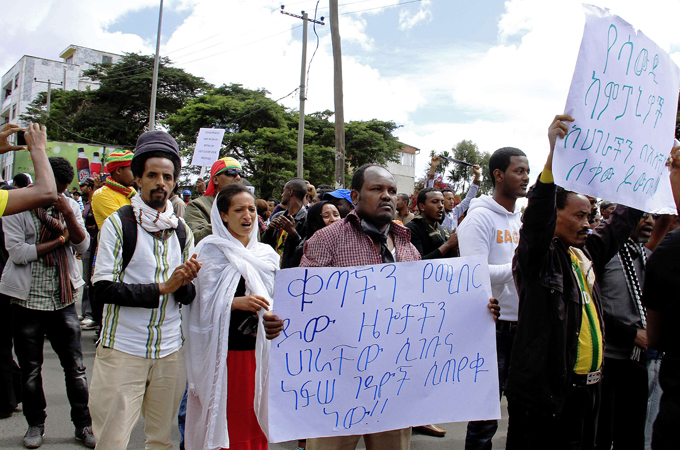
Saudi Arabia: Abuse of Illegal Foreign Workers


Ethiopians protest outside Saudi Embassy in Addis Ababa

The Middle Easts oil rich Saudi Arabia has recently cracked down on illegal foreign workers, Al Jezeera reports here. After a seven month amnesty period the police and vigilantes have allegedly beaten, raped and deported over 100,000 Ethiopians. With unemployment in Saudi on the rise the government is getting tough on illegal workers.
However these illegal workers are not necessarily taking "jobs" from Saudis, with many working as rural slaves unable to pay back debts of people smugglers.
The recent crackdown has also been met with a government and media blank over the issue. The systematic human rights abuses have gone widely unnoticed by the international community. Which begs the question, why is this allowed to happen?
Perhaps the answer lies within the economic relations and dependancy of many nations on Saudi's oil resource. Even the Ethiopian government failed to officially condemn the treatment of its citizens.
The United Nations and International Organisation have committed funds to the repatriation of the workers. However no concrete plans to stop these abuses of foreign workers by Saudi Arabia.
It is imminent the oil will run out in Saudi and perhaps only then will the international community dare to interfere with human rights abuses.